Here and Only Here (2)

Percentage of Life Experience

EYAEL: In this book, one can feel you're drawing really deep onto emotions so there must be a great deal of personal life experience in it. What percentage do you reckon?

CHRISTELLE DABOS: Gosh, I'm totally helpless with figures so I won't speculate on any percentage. But I think there's not a single page in this book which is not alluding to something I either directly experienced or witnessed and which struck me. Then, it's highly transformed as I didn't experience it all literally and because there's still a magical dimension to this story.

It's true that, not so long ago, I had the opportunity to read an excerpt from the book, whereas I hadn't re-read it and I thought, “did I write that, really? Oh yes, that's true. Wow! That's crazy.” Now with a little more perspective, I thought, it's truly a spicy meatball. At the time of writing, it felt very different. That's how I noted the huge discrepancy between what it felt like during the writing process and how it might feel for the reader.

I know the very first draft, when I wanted to write a story about grammar school, before the Mirror Visitor, clearly, I was biased. I think I was resentful. There was a mixture of resentment and guilt. And I think I wanted to settle scores, which is a terrible reason. Fortunately, it didn't happen. Anyway I quickly realised it rang false, so I stopped.

Whereas when this book came to me, I really didn't want to settle scores, I'd rather see things from their own perspective. I thought maybe it wasn't that easy. Ultimately, it's some kind of jungle and that's a defence mechanism like any other.

Still I wouldn't condone all of it. However understanding a different perspective, I think that's what was the most liberating thing for me. Stepping out of myself, my personal history, disengaging from that, and saying "Okay, I'm getting back in the bullring, but with other perspectives which weren't necessarily mine since all the characters aren't like me.”

The characters have nothing to do with me, but it allows me to see things differently. It's another perspective And you can understand. which doesn't mean condoning. There's no judging. Let's say it's not autobiographical, strictly speaking. Otherwise I would have written a life story and personally, I would have found that far less interesting.

But indeed, the aim was to step out of the narrow prism of what I had experienced, of how I had perceived it. And all of a sudden I thought “well, those people I ran along with, how did it feel for them? How did they experience it?” As for myself, to personify that as a writer, that was exciting. I thought, “well, now I'm totally stepping out of my personal history and it's getting larger than my own self.”

It doesn't necessarily mean I will hit home, but I'm trying. I'm trying to see things from another perspective, strictly speaking.

Influences

EYAEL: I can't help drawing a parallel with Stephen King's It novel. However different both words may be, the issues are the same — namely adults turning a blind eye and having no significant presence; repeating cycles; kids disappearing; and even something similar to the “bogs from hell”.

CHRISTELLE DABOS: Well, I must confess I don't think I ever read any Stephen King book. I think the only one I ever read was his essay on writing. Actually, I don't really know his world. But it's disconcerting. Really disconcerting.

EYAEL: It also reminded me of Haraki Murakami, a Japanese author a friend introduced me to — as without realising it, you shift from harsh realism to some supernatural dimension without embracing the codes of fantasy per say. The boundaries are quite blurred.

CHRISTELLE DABOS: Regarding the supernatural dimension, I didn't realise it at the time.It's only later, when asked “Actually, what kind of book is this?” That was right before it hit the shelves. There has been considerable talk with my publisher. Indeed, what kind of book is this?

After careful consideration, I'm thinking about magic realism which is a Latin American literary trend. Actually, when I was a student, I studied Spanish at the university and read some books from this literary trend, such as One Hundred Years of Solitude by Gabriel Garcia Marquez. I think I may also include the House of the Spirits by Isabel Allende. And a novel I really enjoyed was A House in the Country by José Donoso, with such an atmosphere — exactly the type of enclosed place in which sort of coexist a very harsh reality and a small-step-aside dimension that leaves you wondering whether it's true or not. Is it really this supernatural dimension or is it the characters' delusion? It's very difficult to say and I love that! That uncertainty.

But uncertainty is not always well-lived. I think some readers would prefer it to be more clear-cut and to be said. The fact that somehow it's up to them to decide, some like it and some don't. I don't think I'll always systematically write the same type of endings. But in this case, for me, it made sense. I think it's kind of like scales. I do tip them, one way more than the other. But you see, closed endings or which provide very polarised answers are not what I feel most comfortable with. I want to offer something else.

Characters

EYAEL: In my opinion, Vincent and Sofie are the two most significant characters in the story, in the sense that they truly bring change to other characters and advance the plot itself. Still, they're not part of the narrators of this choral novel. Was it deliberate?

CHRISTELLE DABOS: In fact, looking back, but it wasn't during the writing process, I actually realise I pretty much only talk about pairs.

Because the Iris character, her whole story revolves around her sister — her sis; for Madeleine, it's in regard to Louise; for Guy, it's in regard to Sofie; and for Pierre, t's in regard to Vincent. And I realised each of these characters actually develops in regard to another character.

And as you say, in this case, Vincent and Sofie are very interesting characters indeed. They come up with something else. Something totally different from the codes of grammar school. And in a way, they stand on quite hazardous grounds. Here, Vincent puts Pierre at risk. It's both fascinating and dangerous.

As for Sofie, she's the middle way. Personally, Sofie is one of my favourite characters. I think I would have loved to have a Sofie in my class in grammar school. She can see clearly. She can see it's kind of a great delusion ultimately. That it's all a game, really. Some kind of play in which everyone has a role. She says "Okay, no thanks, it's a game. It's just that I'm NOT playing it".

EYAEL: Each character seems to have a highly meaningful name in regard to what they are.

CHRISTELLE DABOS: I know that as regard to naming, for the Mirror Visitor, I had chosen all the characters' names by ear because it sounded great. And then we found out that etymologically it had significant meaning, which was totally unintended. Otherwise it might indeed have been my subconscious at work.

So I said “now I really want to pick up the names in a very conscious and assumed way”. And I do know why I gave each one their name.

EYAEL: So Iris is the one with the all-seeing eye …

CHRISTELLE DABOS: That's right!

Sofie listened to me … what’s that word again? Intently. It’s like she touches my words with every inch of her skin, and captures something underlying them, some hidden meaning that completely escapes me. I really don’t listen like she does.

~ Guy

EYAEL: Sofie is the voice of wisdom … but why is it spelled with an “F”?

CHRISTELLE DABOS: As for Sofie, I did a search as I wanted to know the most popular girl name in the world. And actually, that was Sofie, Sofia, but with an F as the PH was specifically French. I said I want that name to sound the most universal possible.

I’m the odd number, the jack of spades, the lousy kid, and no one can take that away from me.

~ Pierre

EYAEL: Pierre (which also means “stone” in French — Ed.) for hard-heartedness?

CHRISTELLE DABOS: Well, for the character named Pierre, his name actually comes from the jack of spades in the deck of cards. In fact, I knew court cards had names. I knew the names of all the kings and queens, but for jacks, I realised I didn't. So when I found Pierre (Peter) was the name of the jack of spades1, I thought that's perfect.

However, that's just for France. I'm not sure the same goes for other countries.2. So, unfortunately, I think when they translated the book, they kept the original French names. I thought it might have made sense to adapt translations for each country. But it's no big deal.

In retrospect, it's rather a good thing since he's always slouching. There's quite a rock-ish side to him.

And I’m already not that keen on dishing out blows as it is, so receiving them …

~ Guy

EYAEL: Guy (or “gui” which is “mistletoe” in French — Ed. ) is a parasite …

CHRISTELLE DABOS: Actually, for Guy's class, I was very much inspired by Robin Hood. It's really a class where you get two clans, the Top ones and the Bottom ones, with these heavy collections — taxes. Except it's a Robin Hood class without Robin Hood.

Incidentally, in the legend of Robin Hood, there's a character who is quite hard to pidgeon-hole. It's Guy of Gisborne who, according to versions, is either a mercenary or the Sheriff's cousin. But he's quite an ambivalent character. You don't always know whose side he's on. So for this character,  I thought, “clearly he's not a Robin Hood”.

Besides, that's the reason why there's also the Prince figure. He's really Prince John.

It’s either her or me; there can’t be two Chosen Ones Here.

~ Madeleine

EYAEL: Madeleine for Mary Magdalene, the martyr?

CHRISTELLE DABOS: So for Madeleine, I was truly inspired by Saint Mary Magdalene whom, in my mind, I crossed over with — but it's not reflected in her name — Joan of Arc. They are actually two saint figures you can merge into one.

Vincent hums right through trig. The hatred festering in the class has no effect on him. He’s an island, Vincent, always has been; pacifism in flesh and bone, but mainly flesh. Separately, we’re odd ones. Together, we’re nothing.

~ Pierre

EYAEL: Vincent reminds me of Saint Vincent who died laughing and singing under torture.

CHRISTELLE DABOS: Oh no, I didn't know. For Vincent … I can't remember about Pierre's class. I know it must be an odd number, that's what makes me think he's in a class of 25. It's silly but Vincent sounds like 20-100 (in French vingt cent — Ed.). It's actually a 'digit' name. There are names like that. Also, it was really a matter of numbers for this particular class. Pierre is the odd number.

Our proof of the intramural distortion of the field of reality is an unidentified substance that we have called “the schmoil.” The schmoil is the very reason the Top-Secret Club was founded, when Number One discovered its existence forti … fortuitously in one of the school’s gutters, used to drain away dirty water. One aspect sepci … spefic … specific to the schmoil is that it runs in the gutter just once a week, always on a Thursday and always very precisely at 2:28 P.M., but never during the school holidays.

~ The Top-Secret Club

EYAEL: As for the Top-Secret Club, they are some kind of ”conspiracy theorists”, aren't they? The way they're asking all sorts of questions, investigate and notice all the weird stuff others don't or won't see. That thing with the “schmoil”, in particular — couldn't it be related to the pollution of groundwater supplies?

CHRISTELLE DABOS:  Actually, when I was a kid, that was just before grammar school, with my little brother and neighbours, we would explore the neighbourhood and once we came across a super weird substance in a stream. And for us, there was no doubt the substance was either alien or ghostlike. And since we'd just seen Ghostbusters at the movies …

The thing is we couldn't remember the name. The real name was slime. But we had forgotten and so it became schmoil. We totally distorted the name. We collected samples in test tubes. My neighbour had the Little Chemist boxset and so he conducted experiments to see if I mix this with that …

Of course, nothing came up. But please, don't do that at home! If you find a weird substance in a stream, stay away from it!

We just had no idea.

I must confess that's the childhood memory I reinjected. Because honestly, for my neighbours, my brother and I to come across this weird substance, there's something wrong, really. Kids should never come across such highly suspicious substances.

I must say I had much fun with the Top-Secret Club. They really made me laugh.

Incidentally, their names are never mentioned. It's only Number One, Number Two, Number Three, Number Four and so on. And so neither did I want their gender to be known. I never mention it except for Number Three. With that exception, the rest we don't know whether they are boys or girls. I don't mention it and I think it's not important.

However, the question arose for the audiobook as they had hired actors — I think there was one with a female voice. Basically, since it was written, I thought this way no one knows. We have no idea of their identity and it's not important.

Anyway, their thinking is really far-reaching. Because again, there's an autobiographical edge. When I was 13 — that year, I came upon books in my grand-mother's library and I thought, "oh dear!" For me, if something was written in a book, it had to be true. I had absolutely no critical thinking whatsoever. If it's written, if it's printed, then it must be true.

So I came upon books about all sorts of esoteric matters. There was really all sorts of stuff. So I had this adolescent stage when I would see signs everywhere. And for me it was like a mixture of Madeleine and the Top-Secret Club. I was really into that stuff.

And I had fun with them in the sense that they keep predicting an apocalypse, but somehow they're taking part in it. They do remain behind the scenes, but somehow as observers, they're not so neutral as that.

It's true that humour is very important. This is not my easiest book I must say, but the humour … Regardless of them, there are things I wrote which really made me laugh. But between me laughing my head off and the reader potentially timidly cracking a smile, there may be a small discrepancy. Anyway, clearly I went to great lengths with the Top-Secret Club. And I laughed a lot.

And in this regard, I really enjoyed what they did with the audiobook. Incidentally, all the people who discovered Here and Only Here in its audio form have that in common that they all loved the story (I'm one of these people — Ed.). I did listen to the recordings and found they perfectly captured the spirit. That's exactly how they sounded like in my mind.

To be continued in part 3 …

© La Pensine Mutine. All rights reserved. Reproduction prohibited.

Share:

Here and Only Here (1)

I discovered the magic pen of Christelle Dabos in 2013 (same year I created this blog) upon the French release of A Winter's Promise, great winner of the first edition of the First Youth Novel Contest organised by Gallimard Jeunesse and other sponsors in the spring of 2012 and which later became part of the international bestselling Mirror Visitor Quartet, available in some twenty languages. For me, Christelle is somehow a French J.K. Rowling, only better — with all due respect to the latter whose books I still love all the same. Incidentally, Harry Potter may indirectly be the reason she began to write as she would enjoy creating fan-fictions of her own featuring Professor Snape.

I first met Christelle in 2020, on a virtual online book fair during lockdown. Since then, we met in real life in June 2023, prior to a book signing session at an indie book store called Ici Grands-Boulevards in Paris. Finally, on 29th February, I had the great honour and privilege to hold a videoconference call meeting with her to talk about her latest book called Here and Only Here (the title of which is directly derived from the above-mentioned Parisian book store), an unclassifiable choral novel inspired by Latin American magic realism and transposed to the ruthless world of grammar school.

I therefore invite you to watch the resulting video I spent so many nights and days editing — mostly due to countless software issues undermining my workflow. I sincerely hope  it will make you want to read the book. Below is the entire translated original transcript (split in three separate parts given its length) which might be more comfortable to read than subtitles. In addition, you'll even find a “bonus chapter” (People's Reactions) which I had to cut from the video in order to remain within a 30-minute time range.

Under the paint, plaster, and cement, inside the walls, deep in the invisible, I detect something I can’t yet name, something seriously fierce that inhabits the whole school and is seeping into my bones. That will soon be part of me.

Iris

U-Turn

EYAEL: Here and Only Here is starkly different from the Mirror Visitor. Both world and character-wise, but also regarding the storytelling and the language. Was it part of a deliberate effort or just a mere product of whimsical inspiration?

CHRISTELLE DABOS: It just came naturally.

Actually, Here and Only Here wasn't written directly in the aftermath of the Mirror Visitor. What happened is that after I completed the fourth volume of the quartet, the writing process had been so intense I had promised myself to take a year off writing because I was really at the end of my rope. But I didn't last 24 hours!

The next day after the last book hit the shelves, I was writing again. Except what I was writing wasn't Here and Only Here. It was another novel. And in that book, I was already experimenting. So right then, I thought “now I really want to try something else”. Like writing in the first person, in the present tense, in a more oral language, using with various narrators … Just at the formal level, I thought “come on, let's break the mould of the Mirror Visitor”. Pow! Here we go.

And actually, I put this book on pause for a while because I was in the midst of moving home right during lockdown. And that relocation which brought about Here and Only Here really wasn't on the agenda. Really not!

In fact, it's dead simple: I moved in front of a school. And so, at the beginning, it brought back memories. First, memories of primary school which, for me, were rather happy and very light-hearted. And then, since memory has its own linear path, all of a sudden, I shifted back to my grammar school years and I thought “oh, there's something there”.

And during this moving period, I remember I was surrounded by boxes and couldn't write in a structured way anymore. I said “okay, I got something that really, really wants to be told so I'll let it come out as is”.

And I wasn't thinking of publishing it. I wasn't at all. I didn't have a target audience. I didn't think “that's a new project that I'm going to submit”. I never considered it, it just happened.

And I thought “it's okay, I'm going to write a short story about some character”. Then a second character emerged; then a third one; then a fourth… And in fact, it created a sort of alternation. I had no plan. I didn't take any note and it wrote itself all the way through.

Honestly, that's the first time it ever happened on a book project.

To Publish or Not To Publish?

EYAEL: So you never considered publishing it?

CHRISTELLE DABOS: I did think of it, but only once I'd completed it.

Actually, even once completed, I thought “well, there's that thing that came out of me. What am I going to do with it?“

I didn't rush immediately. I left the story to rest for a while. Actually, at the time, I had just recently hired a literary agency and I thought “well, let's start with them for this project”. So I submitted my manuscript and that's how it got into the publishing process.

But to be really honest, I think I was in no hurry to get back into it. Because well, it may not look like much, with the Mirror Visitor — there were many great things, that I can't deny — but there was also a very strong and intense psychological pressure.

So when the lockdown occurred, I was really in a golden interlude. I thought “well, anyway, since everything is on hold, there is no other choice than to take a rest”. And for me, it was writing.

Actually, I found my interlude very comfortable. I knew it couldn't last forever, but it was such a weightless experience. I knew that getting the book into the workings of publication would bring back … not necessarily the publishing process itself, but the fact that there were readers and expectations. Especially in the wake of the Mirror Visitor.

Already, with the Mirror Visitor, I was unable to write unless I ignored stuff. So I had to manage to isolate myself in a bubble in order to write
otherwise I couldn't. And that was difficult to achieve. There were times when I couldn't do it as I had too many things to deal with.

So this time, I didn't have to force myself at all. I was already in that bubble. Besides, the story that came up felt kind of obvious and liberating, kind of saying "There's something in here".

People's Reactions

EYAEL: How was the book received by the readers of the Mirror Visitor and also by your publisher after you submitted your project onto them? Weren't you a bit afraid of what their reaction might be?

CHRISTELLE DABOS: First, as regards to the publisher's reception, I did wonder indeed. I asked myself, "I'm taking such a drastic U-turn in regard to the Mirror Visitor. Are they going to stand by me?”

And they did. They took it all on trust, really. They didn't even discuss it and say “Well, yes, indeed…” There was nothing to negotiate as regard to the manuscript. As soon as they read it, Gallimard Jeunesse accepted it as is.

The editorial manager called me and said: “Honestly Christelle, if I didn't know it was you, I would never have guessed. I'm flabbergasted", he said.

So it was a nice surprise. And they were eager to get started. Literally-speaking, we do get on well with Gallimard Jeunesse. We're quite on the same wavelength and so everything went well regarding editorial decisions.

The important question was now how the audience would respond. How would the book be received ?

It's quite peculiar as I think the most unanimously used term was 'UFO'.

I think people had much trouble classifying it. For some, it was a good thing, but for others it was too disturbing. It's quite difficult to evaluate this way, but I'd already wondered how many people who had read the Mirror Visitor would stand by me with this new project.

Actually, only a fraction did. Those who knew me from the Mirror Visitor didn't necessarily rushed in, saying: “oh, that's the new book by Christelle Dabos”. I think they realised it wasn't the Mirror Visitor. Ultimately, only a relatively small fraction of my readership did take a look into Here. And the feedback among these was quite contrasted.

There were those who thought, “oh dear, we're puzzled, we're not sure about what we've read, it's quite disturbing and so we don't know if we liked it or not” — and for these individuals indeed that was quite an issue. Not to mention that it could bring back memories.

There were those for whom school had been uncomfortable. Which I can perfectly understand. And others who felt the same way: "Yes, we cannot pigeon-hole it; yes, we are baffled, but we like it. We enjoyed the surprise.” That was in that sense.

In this regard, I found that perfectly normal. But what really took me aback — and I certainly wasn't ready for it — was that I had taken for granted that the professionals in the book industry would stand by me as they had with the Mirror Visitor.

One of the reasons why it had worked so well was because book stores, libraries, teachers and the whole system altogether had all embraced and stuck their necks out for it.

EYAEL: What about influencers? I didn't find much on Here and Only Here.

CHRISTELLE DABOS: Influencers too, of course. There was a meeting with 50 female influencers — I insisting on that since there was only one guy against 49 that day. The meeting was organised for the launch of the book by Gallimard. But I don't think all fifty wrote a review. And for those who did, I had no idea whether it was widely shared.

Someone who had seriously boosted the Mirror Visitor was Émilie Bulledop. She is an influencer with a huge community behind her and she heavily promoted the books. It helps when you get people like that doing the job. I can see the difference now and then.

So now I could feel that, apart from Gallimard Jeunesse and I, the project had far less support from other people. Also, when I visited book stores, libraries and talked to professionals, I realised that some had truly jumped onto the bandwagon, saying, "we really enjoyed the unexpected turn” — while other said, "that book doesn't really make you keen to be a student. I certainly doesn't make you keen to be a teacher. And it addresses very touchy issues. Personally, I would not advise it to hyper sensitive people”.

EYAEL: In her books, psychologist Christel Petitcollin differentiates overefficients from normo-thinkers in the sense that their neurological wiring are totally different and explains, in particular, how a majority of people will avoid existential issues at all costs unlike the minority with the over-active brain working in a treelike rather than linear way. Which might explain such clear-cut responses on both sides.

CHRISTELLE DABOS: The fact is we may not be all equal as regard to fear as we're not all at the same stage of our journey. For instance, before the Mirror Visitor, I had attempted to write on that issue and it had been a total failure. Because I knew … I think I could feel already …

A couple of years back, I said, "I really want to write a story set in a grammar school to address certain issues”. Even though it was considerably softer than what I did with Here, I quickly felt extremely uncomfortable. I thought, "no, I really can't. I'm not ready”. It's only after the completion of the Mirror Visitor and everything I went through … For it was a very long process: between the first volume and the last, I spent twelve years of my life on it — but it also provided a ground where I had to meet many fears. Meet and embrace them.

So once this long process was over, I was ready. But I can understand. I can understand that every one may not be there yet. I think, for a book, the timing is important. There some books you cannot read before and you cannot read after. There's only a right time to read them. And for me, that was it.

To be continued in part 2 …

© La Pensine Mutine. All rights reserved. Reproduction prohibited.

Share:

A Prayer to Saint Patrick

O Saint Patrick, come to us!
The naughty Leprechauns
Have gone totally insane
Creating havoc all over the Kingdom.
Those lawless demons
Who are challenging you
And unraveling laws,
Are scary as hell.
They got everything painted upside down,
There's no right side anymore.
Everything is at a loss,
Their might is right.

O Saint Patrick, wake up the world!
Shake the legions of sleepy heads,
Bring them out of their deep stupor
To face the Enemy.
Take the scales from their eyes
Before the warmongers,
From beyond our frontiers,
Go tickling the Bear in its lair.
May they stand
Against the Odd
And may the pull of the Light
Win them over.

© La Pensine Mutine. All rights reserved. Reproduction prohibited.

Share:

Pointing His Star

I wrote this story in 2019 when participating in a collective project with other bloggers, the theme of which was a picture by Christophe Kiciak entitled "A Space Oddity" in tribute to David Bowie. Naturally, Indochine's music and Saint-Exupéry's The Little Prince came to mind as well as the violent punitive context of Jupiter's (Macron) minions. The title is a direct reference to an eponymous song by Indochine (in French). Please note, most of the original puns got lost in translation, but I did my best introducing new ones. Hope it does work for you anyway.

Transcript

Stellar castaway from the depths of time, surfing the Milky Way amidst gasses, dust, and white, blue, red, yellow, brown or black dwarf stars, his head still in the clouds and full of nebulae, riding his stark asteroid while aiming at the moon, the singular explorer got pulled in by Earth's gravity.

Snuffed out off orbit above the Étoile by some unfortunate rubber bullet shot from Jupiter's wrath, the starman saw a plethora of stars at noonday—stunning great neon yellow stars—and then... nothing! Supermassive black hole. He'd been pulling so hard on his comet, his lucky star turned pale and flew off to less bellicose climes.

A very long time ago—eons ago, when he was still a very young prince, the starman inherited the throne from his father. And he began to feel so lonely on his tiny little planet in the far outback of the universe. A planet so tiny and unimportant, it didn't even have a name. Just an alphanumeric identification code assigned by a Turkish astronomer, one day, after a long observation through his telescope.

Mainly busy at sweeping volcanoes to prevent the destruction of his asteroid, and uprooting baobabs so that they don't overrun it, this tireless routine weighed so heavy on him, he ended up brooding.

He brooded so much that one evening, on a pitch black night, from the rocky soil sprang up a sublime dark rose. And he loved her passionately to the moon and back.

But the sulphur-fed beauty enjoyed so much playing with fire, she blew his mind. She pulled the weeds over his eyes with a promise to get high up on cloud-nine.

But instead of a honeymoon, he got green cheese and resorted to moonlighting, baying at the Moon, attempting to pull out each of the four thorns of his inconsistent rose.

Since the Moon had waned off, he proceeded to count the stars in the heavens, shouting at her that he would eventually get her. Thus began his odyssey in search of the Moon and of the plurality that would put an end to his singularity.

But before he could land anything on Earth, he was brought down by a dazzling flash and was immediately taken into custody as there was more than met the eye.

They tried to get him to spill his guts, whereas he got the bullet in his eye (damned fools), and take the kitty out of the bag, banging the eardrums. So much for shooting in the dark for he also had turned stone-deaf. And then, anyway, on his planet, there were no cats nor fools. Only a shady rose he started regretting.

“If you love a flower which is one of its kind on the millions of stars in the sky, it is enough to just look at the stars and feel happy. You can say to yourself, ‘I know my flower is out there somewhere.’ But if a sheep eats the flower, all the stars will seem to darken.”

His words rang so earnestly and so in tune with his heart, so pure and innocent, he won over our entire planet. At least, those earthlings who still had a hint of humanity left within. That is to say, not many.

But enough to turn the tide, extinguish volcanoes, and uproot baobabs.

And he added, “But the eyes are blind. One must see with the heart.”

And thus, most inadvertently, by the way, the one-eyed blinded prince from faraway became king in the world of the blind.

© La Pensine Mutine. All rights reserved. Reproduction prohibited.

Share:

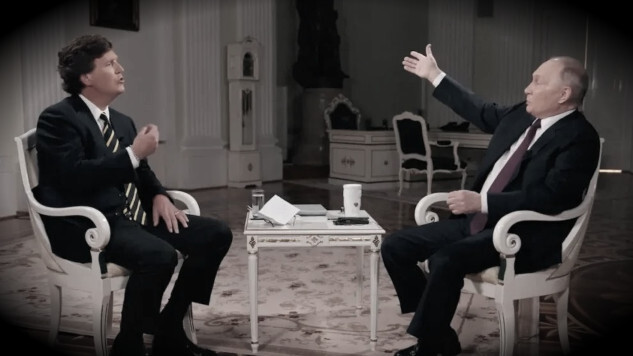
What NO ONE Is Saying About Tucker Carlson’s Putin Interview

Doubt is a corollary of intelligence. So is humility.

Christel Petitcollin

I don't know what I don't know” keeps repeating US-based Ivorian podcaster Mohammed Diallo, stating the obvious. And he's absolutely right on that point. With all due respect to every “experts” and dogmatists of one kind or another, no one holds the truth. Period. Everyone can make mistakes including those who've always been showing great discernment – and that, the human ego, terrified of anything it cannot control, has great trouble accepting.

All this to make it clear that the article below reflects the author's views, not necessarily mine. However, the reason I chose to share it with you is because, in my opinion, he makes some valid points (remember “rogue“ mainstream journalist Richard Boutry in France) and my gut feeling is that it's all too easy. I hate to burst the bubble and sound like a black-pilled purveyor of disinformation, the fact is those who've been pulling the strings on this planet for so long are not as stupid as some wrongly assume. It would be very naive or very arrogant for us to believe that “draining the swamp” will be enough to make the world a good place to live in. I'm anticipating the outrage, but if the world is what it is today – if those corrupt entities have been able to cause so much damage for so long, it's essentially our fault as humankind. Just look at how we behave at the smallest level, the thoughts we entertain, the words we speak, etc. “It's not me, THEY started this!” Anyway, I won't go over things I keep repeating at length on every occasion. As long as we keep fuelling the same storylines within, in our subconscious, the movie won't be any different no matter how many times you change the sets and actors.

Nothing will ever change even with the most honest leaders in the world (as if such utopia could somewhat exist, which I'm very doubtful about) as long as the grassroots (us) are ungrounded and bogged down in their mind fog and magma of discrepancies. Let's grow up. Let's step out of the schoolyard. Let's stop believing in unicorns and let's work on shifting our inner vibration to pull our own Excalibur out of the stone. No one can do it for us. Everything else is a distraction to prevent us from getting on with the job, for once we all regain our sovereignty, no self-proclaimed king of the world can ever claim our kingdom as theirs – that inner sanctuary harbouring the magic lantern projecting the film on the outside world. Feel free to dig in my Pensieve for more details on that inner work. I even designed a map to help you find your way. If you're still around, it's because you can do it.

Ey@el

Everyone is talking about Tucker Carlson’s interview with Russian President Vladimir Putin.

The two-hour long conversation was live-streamed on twitter. Every major news outlet has had some form of coverage.

You can watch the whole thing HERE.

After eight years of covering the Ukraine coup/civil War, and more specifically Western propaganda on Russia, I could pretty much tell you everything Putin was going to say before he said it.

Anybody who has covered Russia or Ukraine could tell you that.

He was always going to detail, in cogent and historically literate terms, Russia’s position on Ukraine.

He was always going to cite the (very real) broken promises Western diplomats made about NATO’s Eastward expansion.

He was almost certainly going remake his very worthy point about US foreign policy never seeming to change no matter who is President.

He’s an intelligent and persuasive speaker, and he was always going to do well.

And, if this was 2014, that would be great.

But it’s not 2014 is it?

It’s 2024 & the world is being hurried fast toward the Brave New (“multipolar”) Normal. Russia is on board with Agenda 2030 & very powerful western establishment voices are now promoting Putin & his once-sidelined views.

In the face of these realities we should be asking questions about the relevance and purpose of this kind of geopolitical theatrics.

Let’s remind ourselves again that everyone is talking about the Putin interview.

EVERYONE.

From Hillary to Elon to Russell Brand.

Every major news outlet covered it, too. Maybe they “fact-checked” it, maybe they ranted about it or insisted it be banned, but they were all talking about it.

Let’s compare and contrast that coverage to the coverage of Oliver Stone’s 4-part interview with Putin in 2017.

Seriously. Look at the difference. It tells you a great deal about how the establishment agenda is changing. There were no big headlines then.

But I don’t want to talk about Putin. Because everyone is talking about Putin.

Read more...

© La Pensine Mutine. All rights reserved. Reproduction prohibited.
Share:

The Year of the Dragon

Our greatest fears are like dragons keeping our deepest treasures.

Rainer Maria Rilke

As mentioned earlier last month, with this new moon in sidereal Capricorn marking the beginning of the Chinese New Year, today we are leaving the Black Rabbit hole (water) to enter the Green Dragon's den (wood) – the terrifying fantastic creature found in all human myths and legends from time immemorial.

In Western mythology (Greek, Celtic, and Norse), it's a reptilian winged creature capable of breathing fire – a symbol of power of natural forces heroes or gods must fight to restore order on Earth. Christianity then turned it into a symbol of evil, the Beast of Revelation,  the embodiment of Satan and paganism.

On the other hand, in Eastern mythology, though likened to natural forces, dragons are dangerous yet not really hostile unlike their Western counterparts. They also look different, finer and airier and not always winged.

The Chinese dragon is a symbol of good luck, power, and noble soul.

Since ancient times, Chinese astrology, based on the position and movement of stars and heavenly bodies, had been the sole privilege of the Emperor. In order to prevent the populace from accessing the secrets of astrology that would allow revolutionaries or invaders to determine the most favourable times to attempt a coup or an invasion, alternative systems were created.

According to folklore as previously explained a couple of years ago, “the Jade Emperor wanted to pick twelve animals to join his inner circle. So a Great Race was organised to access the Heavenly Gate where each animal would be ranked according to their order of arrival”.

Much to the Emperor's surprise, since being the only winged animal, the Dragon only came fifth. Its generous heart allegedly being the reason for its arriving late as on the way, it took the time to make it rain to help humans irrigate their crops before blowing on a wood chunk on which the Rabbit had got stuck when attempting to cross the river, allowing the latter to reach the other side and come to the Emperor just ahead of the Dragon.

Xīn nián hào!

© La Pensine Mutine. All rights reserved. Reproduction prohibited.

Share:

Illusion of Divine

Carrying the marks of your emptiness,
New wounds still bleeding in your chest.
No respect for your own flesh
Expecting a blessing,

Your chant is an elegant complaint,
So sad and slow like a requiem.
No glory in self-induced pain,
Changing your own ending.

The raging storm in your head
Is begging you not to stay.
Free yourself from eternal death,
See the pure light of day.

You flew too far with broken wings,
Wanting to end your sufferings.
Don't you lie with your innocence,
It's just illusion.

Illusion of Divine,
A taste of death is sublime.
Gambling with your soul;
Evil will rise if you fall,
Illusion of Divine.

Never let your madness
Believe in this dying faith.
Your soul is your shelter,
Don't ever surrender.
A mystic light shines your day.

Stigmata showing your insanity,
Crawling on your knees until you bleed.
Worthless moments of glory,
It's just illusion.

Illusion of Divine,
A taste of death is sublime.
Gambling with your soul;
Evil will rise if you fall,
Illusion of Divine.

Illusion of Divine,
A taste of death is sublime.
Gambling with your soul;
Evil will rise if you fall,
Illusion of Divine.

Original text by AMÉLIE PAUL

Share:

Guestbook

If you enjoy this blog, feel free to leave a comment in my guestbook.

Newsletter

Subscribe to my newsletter so you don’t miss any new posts..

Featured Post

Witches Burn

Satanic to some, pagan to others, commercial to most, the celebration of Halloween leaves no one indifferent. If only because it has...

Contact Form

Name

Email *

Message *