By dint of hearing bells jingle all the way, Tinker Bell has mutated into the Mad Hatter, singing "Brother John" on top of her head—the latter, by chance, remaining firmly screwed into her neck in spite of the darts and fits of the Queen of Hearts, stubbornly obsessed with being a pain in the neck and getting the head of anyone above and below daring to stand up to her. Could it be that her heart has lost its reasons that reason itself ignores? No one knows. And if no one gets it, it means everyone's lost it. That's quite devious, I admit, but never mind, it's a big deal. And at the end of the tale, damn the cost, the Royals don't count. Whatever the fat death knells alarming all the way may say, on the day of the Three Kings, we shall omit the trinkets. End of the line.
We're living in a time when it's dangerous to label each other. Labelling is the worst thing we can do to each other because that breaks any path of communication. So I hope that people come to see the film and that we stop this collective thinking — this collective opinion. We should have our own opinion. I've been in many circumstances where people already had an opinion of the film without even seeing the film. It's just based on other people's opinion. And I hope that here, in France, people go and experience the film for themselves and create their own opinion based on what they think.
Alejandro Monteverde
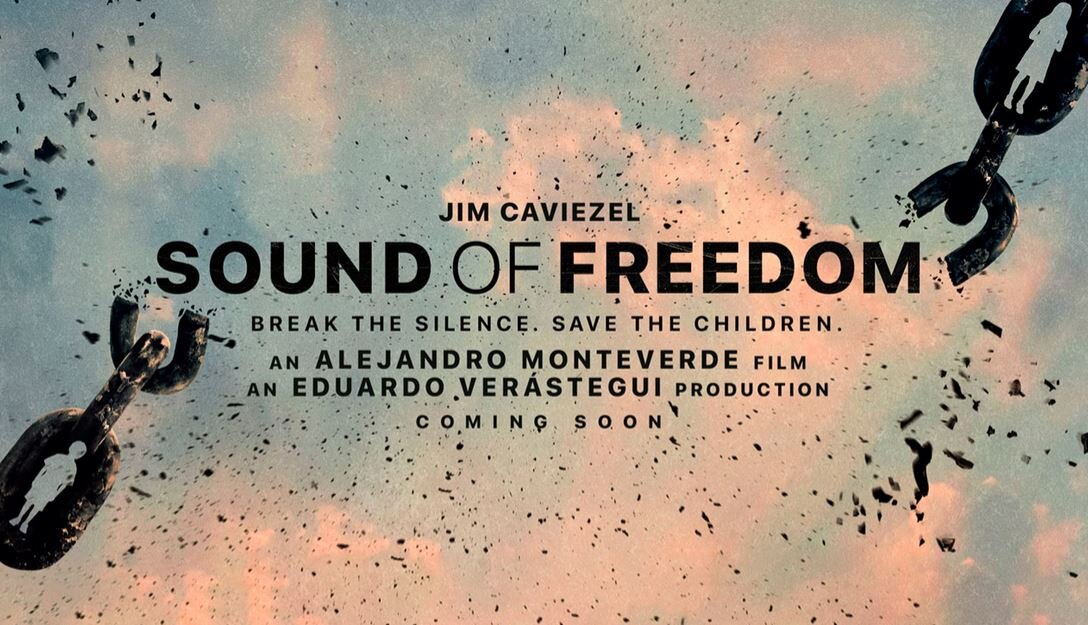
Sound of Freedom by Mexican director Alejandro Monteverde is probably the most controversial movie at the moment. On the one hand, it's a box office smash in America where it hit number one overnight with $14.3 million tickets sold in 2,634 theatres right ahead of Indiana Jones 5 with $11.7 millions in 4,600 theatres (that's twice more). On the other hand, it's being slagged off by Western media as a “conspiratorial” movie featuring “a misrepresentation of the reality of human trafficking” (Wikipedia) while some simply claim it's a “third-rate movie” (BFMTV).
Sophistry's Misfortunes
Filming began in 2018. The majority of the film was shot in Colombia with additional scenes in South California. Sound of Freedom initially had a deal with 20th Century Fox, but when the studio was purchased by Disney, it shelved the film as its subject “did not match Disney's rather consensual editorial line”. Eventually purchased, four years later, by Angel Studio, an independent platform, Sound of Freedom was finally released on 4th July as America celebrated Independence Day, and (in a limited number of theatres) in France via Saje Distribution on 15th November.
Please, note that one of the arguments fuelling the controversy in mainstream media is based on the Christian convictions of the parties involved.
“We were shocked by the controversy around the release of the movie in the USA, last July, as there was such a gap between that and the content of the movie” stated Saje Distribution in a press release following the announcement of the theatrical release of the movie in France. “So far, the movie was obviously impacted by the political antagonisms in America.”
According to French daily Le Parisien, the movie in itself is not conspiratorial, but it would be easy to use it as such: “Conspiracy theories are all implied but never clearly mentioned.” Same goes for Le Monde, claiming that Sound of Freedom “is not a conspirationist movie per se”, but “driven by a cast receptive to this kind of rhetoric”.
Human Correctness
Which is absolutely mind-blowing when you watch the movie unbiasedly. Which side are we supposed to take, by the way, if saving the children is not politically correct?
That is the question independent French journalist Karl Zéro and director Alejandro Monteverde pondered on: “This subject does not belong to any political party. This subject belongs to the human race and we need to transcend that.”
“I don't know anyone who is for child abuse, at least publicly” says Monteverde. “So I thought it would be something that was going to unite us. Which it did with the public. There was a massive division in the media and attacks, but it's always been about creating awareness, because I believe children should be protected by the world.”
Based on A True Story
Sound of Freedom is a thriller based on the incredible true story of Tim Ballard, a former federal agent (brilliantly portrayed by Jim Caviezel) embarking into a rescue operation and risking his life in order to liberate children from the hands of sex traffickers in Colombia.
Left: The real Tim Ballard Right: Tim Ballard in the movie
Father of nine, Ballard was fully unaware of child trafficking until the CIA appointed him to catch paedophiles. That is when he came to realise that the means allocated to fight this issue — which is far greater than people imagine — were seriously inadequate. Hence in 2013, he decided to quit his official job to create his own non-profit NGO called Operation Underground Railroad standing for O.U.R. Rescue.
He teamed up with former U.S. marines and people from the film industry to film his operations and make hard-hitting documentaries. So far, he's released three, but I could only find two of them. These are Operation Toussaint and The Abolitionists.
“The idea of making a feature film that would strike a blow at even more people naturally followed” says Karl Zéro.
Sound of Freedom is thus a mix of various operations in Haiti and Colombia.
At the end of the movie, we are told that:
Tim [Ballard]'s testimony about the Colombian operation led the United States Congress to pass legislation increasing international cooperation in child trafficking cases.
Human trafficking is a 150 billion dollar-a-year business. The United States is one of the top destinations for human trafficking and is among the largest consumers of child sex.
There are more human trapped in slavery today than any other time in history — including when slavery was legal.
Millions of these slaves are children.
A Deeply Moving and Poignant Film
Having seen Sound of Freedom in its original version, I found it both beautiful, poignant and deeply moving, which naturally leads to rethink many things through. It's a decent movie which, unlike a majority of Hollywood (and TV) productions today, doesn't resort to horrifying visuals and gratuitous violence to shock the minds of the viewers.
This is a movie not without some suspense, featuring beautiful pictures and excellent actors — including the children. Nothing is seen, everything is suggested, which is what actually makes it so effective.
Sound of Freedom is a multifaceted film which thus provides food for thought. That's probably its most upsetting aspect. For beyond the main message aiming at raising public awareness of child trafficking, is the idea of redemption conveyed by the Vampiro character — also known as Batman and based on a real-life character with a few alterations for script commodity — a former money launderer for an infamous drug cartel who, after a sudden awakening, decides to use his ill-gotten money to rescue children.
This just shows that changing course and breaking free of the spiral of evil can be possible. Of course, as Omraam Mikhael Aivanhov says, there's always a price to pay, but there is a way out. No wonder why it's so inconvenient.
When you have learned to act well, when all your actions and all your words are inspired by kindness, purity and disinterestedness, they will not entail any ‘karma’ but will attract beneficial effects. This is called dharma.
Today, on the fourth Thursday of November, the United States are celebrating Thanksgiving. Please note, this public holiday is not about sleeping late nor tending to your cacti or eating lots of fats† (not so sure about that one, though), but all about thanking God “for the providential New World and fruitful cooperation with its native populations”.
Which goes to show that a bad liver may surely kill you while bad faith won't.
The Final Blow
Right after the celebration of the Native American genocide with God on their side, the final blow is being delivered on the infamous Black Friday — also known as “Mad Friday” in Quebec (a name I agree with 1000 percent). This is the time when there's a free-for-all rush on stores by ungraceful American housewives — much like a rugby scrum — so violent and thunderous no one can hear you cry for mercy.
It's a black Friday indeed for the police in charge of dealing with the chaos of heavy traffic congestion, accidents, shoplifting and other issues arising from these consumption binges.
What about Saturday?
Vade Retro Jupiter
As the ruling planet of Thursdays, Jupiter symbolises abundance, social fulfilment but also excess and overindulgence. Jupiter in retrograde phase until the end of the year invites us to turn inwards, to be more attuned to our inner voice and to the meaning of life, and change what's not right.
Let's make the best of a bad job and let us be touched by grace.
Namaste,
End notes
^Sorry, some puns got lost in translation! Basically in French, grace sounds like “grasse” which means fat, hence “matière grasse” (fats). It is also used in idiomatic expressions such “grasse matinée” (literally “fat morning”) and “plantes grasses” (succulents) in the cacti reference.
The flu is here no more Did it make you terrified? You looked for contagion Within the big lie You bonded together In a criminal world
You're so superficial And think that you're special But you're a sheep You're a weirdo Why the hell do you live in fear? What's going on here?
I don't care if it hurts You've given up control You're gonna wreck your body And sell out your soul I hope that you notice Everyone's still around
You're so superficial Yet think that you're special But you're a sheep You're a weirdo Why the hell do you live in fear? What's going on here?
Oh... Oh... He's conning us again He's conning us A con... Con! Con! Con! Con!
Wearing your face nappy You'll get what you want
You're so superficial Do you think that you're special? Well, you're a sheep You're a weirdo Why the hell do you live in fear? What's going on here? Yeah, what's going on here?
One song that's more relevant than ever today is "War", originally written under the famous Motown label to be performed by The Temptations and finally recorded by Edwin Starr to become a major hit and probably the most popular protest song ever. During the following decades, it has been covered by countless artists. Clearly, music doesn't soothe minds — at least not for everyone.
As a bonus, I'm also including an excellent cover by The Jam, which is my favourite because that's how I got to hear this song first. May it become a mantra.Ey@el
War, huh yeah What is it good for? Absolutely nothing, oh hoh, oh War huh yeah What is it good for? Absolutely nothing, say it again y'all War, huh good God What is it good for? Absolutely nothing, listen to me
Oh, war, I despise 'Cause it means destruction of innocent lives War means tears to thousands of mothers eyes When their sons go off to fight and lose their lives
I said War, huh good God y'all What is it good for? Absolutely nothing, just say it again War whoa Lord What is it good for? Absolutely nothing, listen to me War, it ain't nothin' but a heartbreaker War, friend only to the undertaker
Oh war, is an enemy to all mankind The thought of war blows my mind War has caused unrest within the younger generation Induction, then destruction — who wants to die ?
War, good God, y'all What is it good for? Absolutely nothing, say it, say it, say it War, uh huh, yeah, huh What is it good for? Absolutely nothing, listen to me War, it ain't nothin' but a heartbreaker War, it's got one friend that's the undertaker
Oh, war has shattered many young man's dreams Made him disabled bitter and mean Life is much to short and precious to spend fighting wars these days War can't give life it can only take it away, ooh
War, huh, good God y'all What is it good for? Absolutely nothing, say it again War, whoa, Lord What is it good for? Absolutely nothing, listen to me War, it ain't nothin' but a heartbreaker War, friend only to the undertaker
Peace love and understanding tell me Is there no place for them today They say we must fight to keep our freedom But Lord knows there's got to be a better way
War, huh, good God y'all What is it good for? You tell 'em, say it, say it, say it, say it War, good Lord, huh What is it good for? Stand up and shout it, nothing War, it ain't nothin' but a heartbreaker
Here comes the woman With the look in her eye, Raised on leather With flesh on her mind, Words as weapons sharper than knives, Makes you wonder how the other half dies.
Here come the man With the look in his eye, Fed on nothing But full of pride. Look at them go, Look at them kick, Makes you wonder how the other half lives.
The devil inside... The devil inside... Every single one of us the devil inside.
The devil inside... The devil inside... Every single one of us the devil inside.
Here comes the world With the look in its eye, Future uncertain but certainly slight. Look at the faces, Listen to the bells, It's hard to believe we need a place called hell.
Until now, I had to store my handful of audiobooks in my Kodi music library since it wasn't possible to add them to Calibre alongside my other books, which wasn't very convenient not to have everything in the same place. Especially when you have the same audiobooks in other formats (digital or hard copies). But now, that's ancient history since Calibre's developer Kovid Goyal finally has implemented this missing functionality.
How to Add Your Audiobooks to Calibre
Click on Add books - Add Empty Book (CTRL+MAJ+E).
Thereupon you need to enter the number of books you wish to add, author's name, series title and book title (these options are especially helpful if you had a whole series or collection of books by a same author and wish to save the trouble of manually filling in these fields for each book) then click OK to valid.
Your book is now displayed in the cover browser (or list depending of how you have configured Calibre to look like) and you may fill in the missing information by clicking on Edit metadata individually and proceed as you would for ebooks.
Once done with the metadata, click on Add Books - Add data files to selected book entries then select all the audiofiles of your audiobook folder and click OK.
Select your book again and right click to Open Book Folder - Open Book Data Folder.
In the data folder where Calibre has previously copied all your book audio files, select all files and open them with your media player to create a m3u playlist which you may save in a temporary folder.
Back to Calibre, Edit metadata individually then Add new format for this book and select the m3u playlist you've just created with your media player and click OK.
You will now be able to play your audiobook by clicking on this format in the book details as you do for ebooks.
NOTE: Same as for ebooks, you may delete original audio files and playlist as Calibre has copied them all in its library.
A New Easier Way to Catalog Your Printed Books in Calibre
Six months ago, I explained how to add printed books to Calibre by creating as many dummy TXT files, which was quite a tedious task. Now there's a much easier and quicker way to do that as we saw while adding audiobooks since all you need to do is Add books - Add Empty Book then edit metadata as previoulsy explained.
If you've used my old method, you may delete the dummy text files using unneccessary space on your hard disk by selecting your books and Delete specific format files for selected books.
Thereupon a list of format will be displayed according to what's available in your selection of books. Just tick TXT then OK and you're done.
NOTE: If you have books both in paper or digital format, no need to create several entries for the same books. Instead create customized columns for printed book formats which you may then fill in manually where applicable. I have also added a field for audiobook length.


 FR
FR